
India's share in world tourist inflows was only 0.64 per cent in 2012. It could only attract 6.97 million foreign tourists during 2013.

'Two consecutive quarters of negative growth are the technical definition of an economic recession, and for the first time in this generation's memory, we may be staring at one,' observes Aakar Patel.

Revenue buoyancy of GST will be key to improve the resource position of both central and state governments.

As we brace for unprecedented rates of urbanisation, it is crucial to ensure that illegal constructions and unauthorised land use are curbed, asserts Amit Kapoor.

The services sector growth in India fell to a one-year low in November on softer expansions in new work intakes and output, despite receding price pressures, a monthly survey said on Tuesday. The seasonally adjusted S&P Global India Services Business Activity Index fell from 58.4 in October to a one-year low of 56.9 in November. Despite witnessing a month-on-month decline, the rate of expansion was stronger than its long-run average.

Bolstered by improved domestic demand, India's services sector expanded for the fourth consecutive month in January as business activities quickened and rising business optimism is set to sustain the growth momentum, a monthly survey said on Wednesday. The seasonally-adjusted India Services Business Activity Index rose from 52.3 in December to 52.8 in January, pointing to a quicker expansion in output. The index was above the critical 50 mark that separates growth from contraction for the fourth month in a row during January.

Ahead of the 2023-24 Union Budget, the thinking at the top level of the central government is clear: Gross domestic product (GDP) growth of 6-6.5 per cent is a comfortable enough target for FY24 and the focus should be on fiscal consolidation to ensure that the sovereign cost of borrowing does not become prohibitively expensive in a high-interest rate environment, according to people in the know. Those aware of deliberations between the Prime Minister's Office (PMO) and the Ministry of Finance said while the Budget would look to strike a balance between infrastructure investment and welfare schemes, it is unlikely to be populist, though it will be the last full-year Budget before the 2024 Lok Sabha election. Incidentally, 6-6.5 per cent GDP growth is what the upcoming 2022-23 Economic Survey is expected to project for FY24.

The Opposition had promised to scrap the Dharavi redevelopment project if it came to power. With the Mahayuti's massive mandate in the Maharashtra assembly election, that prospect has been laid to rest.
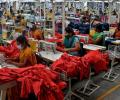
Enthused by higher than expected GDP numbers in the fourth quarter of 2022-23, Chief Economic Adviser (CEA) V Anantha Nageswaran on Wednesday said India's economic growth may exceed the initial estimate of 6.5 per cent in the current fiscal and the country can look for another year of solid economic performance.

Policy rates have been reduced substantially in 2015.

A cultural preference for sons in India may be expressed as 'son preference' or 'daughter aversion', arising from patrilocality, patrilineality, the cost of dowry, and old-age support from sons.

Most economists expect the global economy to weaken in the coming year amid political and financial volatility, but a large majority of over 90 per cent are confident of moderate or strong growth in South Asia, notably India, a survey showed on Friday. At the same time, the outlook for China has dimmed following signs of deflationary pressures and fragility in the country's real estate market, the World Economic Forum's latest 'Chief Economists Outlook' report said. As the world grapples with political and financial volatility, almost six in 10 believe the global economic outlook will undermine progress towards meeting the UN Sustainable Development Goals (SDGs), with 74 per cent saying geopolitical tensions will have the same effect.

Chief economic advisor V Anantha Nageswaran on Tuesday said Indian economy will grow at over 7 per cent, down from above 8 per cent of growth rate projected in January. He, however, said that the economic momentum and the animal spirits are "unmistakable". "India's own growth rates have come off the projections made in January down to about 7-plus per cent for the current financial year," Nageswaran said speaking at Global Fintech Fest event in Mumbai.
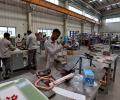
In a relatively rare occurrence, the growth in manufacturing jobs exceeded the pace of sector growth in 2022-23 (FY23). The number of persons engaged in the segment grew by 7.43 per cent in FY23, according to figures from the Annual Survey of Industries (ASI) released on September 30. The gross value added for the manufacturing sector grew by 4.24 per cent in current prices and declined by 2.2 per cent in real terms for FY23, according to earlier annual figures released by the government.

About 80 per cent of the investors in India said that the economic situation has improved, whereas around 77 per cent investors in China believe so, as per the latest quarterly ING Investor Dashboard survey.

The vaccination drive was only one important part of India's globally recognised pandemic management and response strategy, observes Dr Vinod K Paul.

The ministry of finance is likely to assume crude oil price to remain within $85 per barrel while estimating subsidies for the Interim Budget 2024-25 (FY25), to be presented on February 1. Brent crude prices moved up on Thursday, ending at $78.9 per barrel. Crude oil and cooking gas prices, which move in tandem, impact fertiliser and cooking gas subsidies, constituting 53 per cent of the government's total subsidies.

The Youth Economics: Career Expectations survey by PHD Chamber of Commerce and Industry paints an optimistic picture.

The findings of the report showed consumer spending falling for the first time in over four decades in 2017-18.

'Our study finds that only about 20% of Indians are vegetarians and the rest of the 80% are non-vegetarians or meat-eaters.'

India remains an attractive destination for foreign direct investments (FDI) on account of healthy prospects of economic growth and its skilled workforce, according to a survey by Deloitte. A large proportion of international business leaders remain confident in India's short- and long-term prospects and are readying plans to make additional and first-time investments in the country, it said on Tuesday. "The survey, which questioned 1,200 business leaders of multinational corporations in the US, UK, Japan and Singapore, found that India remains an attractive destination for investments, scoring highly for its skilled workforce and prospects for economic growth," the survey - India's FDI Opportunity - said.

Is it is necessary to play divisive politics to succeed in the next general elections? asks Dr Sudhir Bisht.
India Inc's investment in all aspects of social networks, mobile computing, analytics and cloud computing (SMAC) is consistently surpassing its global counterparts.
The report on the Economic Freedom of the States of India is the latest in a series of annual surveys on the economic freedom of Indian states, which started in 2004. The latest report takes 2009 as the period under review.
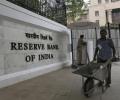
It further pointed out that the twin balance sheet problem -- at the end of banks and corporate -- more attractive interest rates for borrowers in the bond market and from non-banking financial institutions are other reasons for slow bank credit growth.

Armed with necessary macro and micro growth drivers, India is on its way to becoming the fastest growing major economy in the world, a finance ministry report said. Rapid vaccination and teeming festivities will push India's ongoing recovery resulting in narrowing of demand-supply mismatches and greater employment opportunities, as per the monthly Economic Review prepared by the ministry.

India needs to spread irrigation and do so against a backdrop of rising water scarcity and depleting groundwater resources

Workplaces of 2025 will be defined by a deep focus on people-first values, inclusivity, and sustainable growth, foresees Sonica Aron, founder of Marching Sheep.

Policymakers should consider the challenges of beneficiary identification, distributor opposition and beneficiary financial inclusion.

If it continues to do well economically, develops a large manufacturing sector, gains in technological heft, builds a more capable defence industry, improves its human development indicators, becomes more of a trading nation, and has greater internal cohesion. In short, it is a work in progress, suggests T N Ninan.
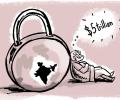
India decisively withstood global headwinds in 2023 and is likely to remain as the world's fastest-growing major economy on the back of growing demand, moderate inflation, stable interest rate regime and robust foreign exchange reserves. Despite widespread pessimism witnessed among the developed nations and the worsening geopolitical situation, India recorded a gross domestic product (GDP) expansion of 6.1 per cent in the March quarter. The growth moved up to 7.8 per cent in the June quarter and was 7.6 per cent in the September quarter. For the first six months of this fiscal, the growth was 7.7 per cent.
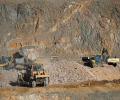
In a step towards diversifying its resource base and securing green energy minerals, India is poised to launch its first-ever offshore mineral auction in the first quarter of 2024, announced Union Minister of Mines Pralhad Joshi during the launch event of the National Geoscience Data Repository portal. The government plans to hold auctions in March, offering 10-15 blocks for bidding. Meanwhile, the ministry of mines is currently developing rules and regulations for offshore mining.

Employment in India saw a V-shaped recovery after being adversely impacted between April and June 2020 during the Covid lockdown and during April-June 2021, when the second wave struck, said Krishnamurthy V Subramanian, former chief economic advisor, in a paper released on Friday. Subramanian is now serving as executive director of the International Monetary Fund (IMF). From the official survey data of the National Sample Survey Organisation (NSSO), the paper titled 'Employment in India: Data Sources, Facts, and Trends' showed that both worker-population ratio (WPR) and labour force participation rate (LFPR) were higher, while the unemployment rate was lower during October-December 2022 when compared to the corresponding quarter in 2019.
The survey was conducted by research firm Ipsos.
The economic slowdown has taken its toll on consumer confidence. India has fallen from the top to third in the latest round of the Nielsen Global Consumer Confidence Survey and now ranks behind Indonesia and Denmark. It is the largest bi-annual study of its kind and is carried out on more than 25,000 Internet users in 50 countries.

Budget 2010 went far beyond most recent Budgets in that it defined an entirely new paradigm for the Indian economy.
Budget 2010 went far beyond most recent Budgets in that it defined an entirely new paradigm for the Indian economy.

Chief Economic Adviser K V Subramanian on Wednesday said India is expected to hit a growth rate of 6.5-7 per cent in 2022-23 and accelerate further to 8 per cent in the subsequent years on the back of reforms undertaken by the government. He also said the government is expected to meet the fiscal deficit target of 6.8 per cent in the current fiscal despite pressure on revenue collections.

'I don't believe there is an international conspiracy to swamp tribals in India or in Jharkhand.'
Rediff.com's data journalists have visualised the National Sample Survey Office (NSS 68th round, July 2011-June 2012) data into a interactive map.
 © 2026 Rediff.com - Advertise with us - Disclaimer - Privacy Policy - Sitemap - Feedback - About us - Terms of use - Grievances